Thursday, March 5, 2015
New Website
The Anglo-Russian Research Network has a new website. Please check https://anglorussiannetwork.wordpress.com/ for all updates about our activities, and a growing archive of podcasts, research resources, and articles.

Sunday, April 27, 2014
British–Soviet Friendship and Cultural Exchange: promotion, partnership and propaganda, Saturday 24 May 2014
This interdisciplinary conference will look at the scope and nature of Soviet culture disseminated in Britain and significance of cultural relations with the USSR in Britain. It will ask what mechanisms of cultural exchange existed, how Soviet culture was presented to the British public and specialists, and what influence these relations exerted on British writers, creative artists and professionals in fields as diverse as law, music and architecture. It will examine the intersection of this subject with related fields and the methodological challenges associated with approaching literature and culture in a highly politicized context.
The event will be held at the Society for Co-operation in Russian and Soviet Studies, 320 Brixton Road, London SW9 6AB.
The Programme is available to download.
The cost, including refreshments, is £20. Please book via the online store here.
This event is sponsored by BASEES
The event will be held at the Society for Co-operation in Russian and Soviet Studies, 320 Brixton Road, London SW9 6AB.
The Programme is available to download.
The cost, including refreshments, is £20. Please book via the online store here.
This event is sponsored by BASEES
Tuesday, April 8, 2014
Reading Group: Simon Dixon on the Russian Orthodox Church and Anglicanism in the Nineteenth Century, 2 May
Professor Simon Dixon, Sir Bernard Pares Chair of Russian History at UCL SSEES, will be leading our next reading group, which will focus on the relationship between the Russian Orthodox Church and Anglicanism. The session will take place on 2 May from 5.30pm-7.30pm at Pushkin House, Bloomsbury (www.pushkinhouse.org). We will be circulating the texts by email soon.

Outline
It is generally supposed that, before the era of W.J. Birkbeck, relations between Anglicans and the Russian Orthodox Church were the preserve of eccentrics on both sides: maximalists such as William Palmer of Magdalen predictably ran into a brick wall; no leading figures were involved. I hope to suggest a rather different picture by highlighting the role of two leading Russian laymen: Count Aleksandr Tolstoi, chief procurator of the Holy Synod after the Crimean War, and his anglophile friend, Count Evfimii Putiatin, who combined an expertise in the latest naval technology with ultra-Orthodox piety. Though eccentrics are certainly to be found (the convert Stephen Hatherly was one), by concentrating on the period 1840 to 1870 we might throw light on a wider set of concerns, focused partly on hostility to Roman Catholicism and partly on the tensions between pan-Slavism and pan-Orthodoxy.
Biography
Born in Lancashire, where he learned Russian at Bolton School, Simon Dixon graduated in History from Sidney Sussex College, Cambridge, where he held a Junior Research Fellowship after studying for a PhD at the School of Slavonic and East European Studies. Having spent nine years lecturing at the University of Glasgow, he was Professor of Modern History at the University of Leeds from 1999 to 2008 before moving to the Sir Bernard Pares Chair of Russian History at UCL SSEES.
The Anglo-Russian Research Network organises termly reading groups for those interested in the interactions between British and Russian culture and politics in the period c.1880-1950. These are informal events with plenty of discussion and wine. Anyone who would like to is very welcome to come along with us for dinner at a local restaurant--it would be helpful to know in advance if you're planning to come to dinner so that we have some idea of numbers. Please contact Matt Taunton or Rebecca Beasley if you would like to attend.
Wednesday, January 8, 2014
Reading Group: Phillipa Burt on Theodore Komisarjevsky, Pushkin House, Feb 21st
We are pleased to announce that Philippa Burt will be leading our next reading group, which will focus on the life and work of Theodore Komisarjevsky. The session will take place on February 21st from 5.30pm-7.30pm. The reading material will be circulated soon, so please contact Matt Taunton or Becky Beasley if you would like to attend and we'll send you the texts.

Philippa Burt is currently completing her doctorate at Goldsmiths, University of London under Professor Maria Shevtsova. The focus of her thesis is the ideal of ensemble practice in twentieth-century British theatre, where she charts the underlying influence of Russian theatre on British directors.
Monday, September 9, 2013
Reading Group: Children's Literature about the USSR, introduced by Professor Kimberley Reynolds

The Anglo-Russian Research Network will be holding its autumn reading group at 5:00 on Friday 4 October at Pushkin House, Bloomsbury (www.pushkinhouse.org). The discussion will be led by Kimberley Reynolds, Professor of Children’s Literature at Newcastle University.
The readings are:
1 Draft of Kimberley’s chapter on children’s books about the Soviet Union published in Britain in the 1930s and 1940s.
2 Extract from Geoffrey Trease, Red Comet: A Tale of Travel in the U.S.S.R. (1936): chapter 6, ‘A New Kind of Park’
3 Extracts from Marjorie Fischer, Palaces on Monday (1937): chapters 6 ‘Upside Down’, 7 ‘And the Moral of That is’, and 9 ‘Black Boy on the Volga’
4 Extract from Pearl Binder, Russian Families (1942): start from bottom of page 47 ‘Mamma Pavolova’
‘The material to be discussed is based on a chapter I am writing for a book about the radical children’s books of the early twentieth century that do not feature in established histories of children’s literature. This chapter looks at representations of the Soviet Union in children’s books published in the 1930s and 1940s in the UK. The chapter will also cover books from the USSR that were published here in translation, but I have not included any of these in the extracts for discussion. Most of the works I discuss are forms of travel writing in that the children in them move between different cities, resorts and regions and give their impressions of the people and projects they see. My interest, and where I will particularly appreciate guidance from the group, is in the way the Soviet experiment was being presented to British children.’
Kimberley Reynolds is Professor of Children’s Literature in the School of English Literature, Language and Linguistics at Newcastle University. She has lectured and published widely on a variety of aspects of children’s literature, most recently in the form of an audio book, Children’s Literature Between the Covers (Modern Scholar, 2011) and the volume on Children’s Literature in the Oxford University series of Very Short Introductions (2011). With Matthew Grenby she edited Children’s Literature Studies: A Research Handbook (Palgrave, 2011). She currently holds a Major Leverhulme Fellowship to research ‘Modernism, the Left and Progressive Publishing for Children, 1910 – 1949’. She is the 2013 recipient of the International Brothers Grimm Award.
It would be helpful if you could let Rebecca Beasley (rebecca.beasley@ell.ox.ac.uk) and/ or Matthew Taunton (M.Taunton@uea.ac.uk) know if you plan to attend, and you will be supplied with digital copies of the reading. All are welcome. The discussion will finish at 7, and anyone available is very welcome to join us for dinner nearby.
The Anglo-Russian Research Network organises termly reading groups for those interested in the interactions between British and Russian culture and politics in the period 1880-1950. These are informal events with plenty of discussion and wine.
Wednesday, July 3, 2013
ARRN Podcast 3: Emily Lygo on the Society for Cultural Relations with the USSR
The third ARRN podcast is now available for streaming or download. Click below to hear Emily Lygo introduce text relating to the Society for Cultural Relations with the USSR. If you would like to be sent these texts by email, please contact Matthew Taunton or Rebecca Beasley.
Friday, May 17, 2013
Emily Lygo on the Society for Cultural Relations with the USSR, 7 June, Pushkin House
Anglo-Russian Research Network Reading Group, 7 June, 5-7pm, Pushkin House
At our next reading group, we are delighted to welcome Dr Emily Lygo, Lecturer in Russian at the University of Exeter. Emily will be introducing texts relating to her research on the history of The Society For Cultural Relations Between the Peoples of the British Commonwealth with the USSR. The reading materials are as follows:
1. An article by Emily Lygo, 'Promoting Soviet Culture in Britain: the History of the Society for Cultural Relations Between the Peoples of the British Commonwealth and the USSR, 1924–45', Modern Language Review Vol. 108 No. 2 (April, 2013)
2. Preface and argument to the book The New Spirit in the Russian Theatre by Huntly Carter, 1929
3. A 1946 edition of the Anglo-Soviet Journal, available online here.
If you would like to attend, please contact Matt Taunton or Becky Beasley and we will send you the reading materials in pdf format.

Sunday, March 31, 2013
ARRN Podcast 2: Michael Hughes on Stephen Graham
Our second podcast is now available for download or streaming. Here, Professor Michael Hughes discusses the British travel writer and novelist Stephen Graham at an Anglo-Russian Research Network reading group in Spring 2013.
Please contact Matthew Taunton or Rebecca Beasley if you would like to be sent copies of the reading materials.
Tuesday, February 12, 2013
ARRN Podcast 1: Angus Wrenn and Olga Soboleva on George Bernard Shaw
We are pleased to bring you the first Anglo-Russian Research Network podcast. Here Angus Wrenn and Olga Soboleva discuss readings relating to George Bernard Shaw and the Russian Revolution. Please contact Matt Taunton or Becky Beasley if you would like us to send you the readings associated with this discussion. We will be making future presentations from our termly reading groups available in this format so please check back.
Wednesday, January 23, 2013
Michael Hughes on Stephen Graham and Russia, Pushkin House, Friday 15th February 5-7pm
We are delighted to welcome Professor Michael Hughes (Professor of Russian and International History at the University of Liverpool) to our next reading group. Michael will be introducing texts by the British travel writer and novelist Stephen Graham, and a chapter that he has recently authored on Graham in A People Passing Rude: British Responses to Russian Culture, ed by Anthony Cross and available online (and for free!) here.

Michael also maintains an excellent website about Graham, here.
The reading group will take place at Pushkin House on Friday 15th February from 5-7pm. Please contact the organizers Matt Taunton and Rebecca Beasley if you would like to attend, and we will send you the reading material in advance of the meeting. We look forward to seeing you there.
Wednesday, October 10, 2012
George Bernard Shaw and Russia: Wednesday 28th November
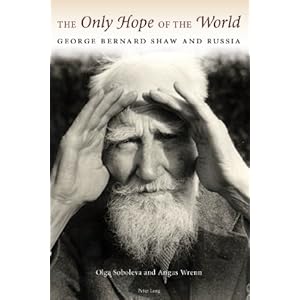
The next in our series of reading groups will be on George Bernard Shaw and Russia. We are delighted to welcome Dr Olga Sobolev and Dr Angus Wrenn (both of the LSE), authors of The Only Hope of the World: George Bernard Shaw and Russia (Peter Lang, 2012), for a discussion about Shaw and the Soviet Union.

The meeting will take place on Wednesday 28th November from 5.30pm at Pushkin House. We will be circulating reading material closer to the time, and will post details of this reading soon, but in the meantime if you would like to attend please contact Matt Taunton or Rebecca Beasley.
The meeting will take place on Wednesday 28th November from 5.30pm at Pushkin House. We will be circulating reading material closer to the time, and will post details of this reading soon, but in the meantime if you would like to attend please contact Matt Taunton or Rebecca Beasley.
Monday, January 30, 2012
Soviet Cinema and British Modernism - Reading Group, 24th February
The second meeting of the Anglo-Russian Research Network will be a reading group on Soviet cinema and British modernism led by Laura Marcus (Goldsmith's Professor of English Literature, New College, Oxford). The reading group - an informal, termly event that aims to bring together scholars and postgraduates with an interest in the cultural relationships between Russia and Britain in the period 1880-1950 - will be held in the Library at Pushkin House on Friday 24th February 2012 from 5.30-7.30pm. We will be looking at a selection from Bryher's Film Problems of Soviet Russia, which will be will be circulated by email in advance. Please contact Matthew Taunton and/or Rebecca Beasley if you would like to attend. All are welcome.
Thursday, September 29, 2011
Inaugural Meeting
Our first meeting will take place on Friday 4 November at 5:30, at Pushkin House. Stuart Eagles, author of After Ruskin: The Social and Political Legacies of a Victorian Prophet, 1870-1920 (Oxford University Press, 2011) will introduce texts by John Kenworthy, the Tolstoyan writer, publisher and founder of the Croydon Brotherhood Church and the Purleigh Colony. The texts will be circulated by email shortly.
If you would plan to attend the first meeting, it would be very helpful if you could email Becky Beasley (rebecca.beasley@ell.ox.ac.uk) and Matt Taunton (m.w.taunton@qmul.ac.uk) so we have a sense of potential numbers.
If you would plan to attend the first meeting, it would be very helpful if you could email Becky Beasley (rebecca.beasley@ell.ox.ac.uk) and Matt Taunton (m.w.taunton@qmul.ac.uk) so we have a sense of potential numbers.
The Anglo Russian Research Network
The Anglo-Russian Research Network seeks to explore the influence of Russian and Soviet culture and politics in Britain in the period 1880-1950. Through an initial series of reading groups held on a termly basis at Pushkin House the network will convene discussions around key texts (translated from Russian or written in English) that mediate a vital cultural relationship–whether literary, aesthetic, linguistic, economic or political. All are welcome.
Topics covered will include:
- the translation and reception of Russian literature, film and visual art in Britain
- the role of Russian literature, culture and politics in the development of British modernism
- bolshevism and the British left
- the reporting and discussion of the Russian Revolution and Soviet Russia in the British press
- internationalism and Soviet Russia
- Britons in Russia / Russians in Britain
- the development of cold war attitudes and the 'Iron Curtain'
For the purposes of the reading group, each meeting will focus on a text selected and introduced by a member of the network or an invited expert. On the one hand we will examine texts that emerged from Russia and were translated, including novels, films, political tracts and works of criticism. This might cover work by Tolstoy, Dostoyevsky, Eisenstein, Vertov, Gorky, Lenin and Trotsky, and would include consideration of the reception, translation and influence of these texts in Britain. On the other hand, we will discuss texts written in English but directly or indirectly formed by their engagement with Russian culture or politics. This might include the work of intellectuals who visited Russia and wrote about their experiences (such as Wells, Shaw, the Webbs, Keynes, Russell and Muggeridge), as well as texts by writers who never saw Russia, but nevertheless participated in its construction as an imaginary space.
We hope that the network will provide a context for developing future events and publications around this set of issues. Please let us know if you would be interested in participating in the reading group or being involved in some other way.
Rebecca Beasley (rebecca.beasley@queens.ox.ac.uk) and Matthew Taunton (m.w.taunton@qmul.ac.uk)
Subscribe to:
Posts (Atom)